

Why Slow-Release Caffeine Feels Different Than a Regular Energy Drink
Quick answer
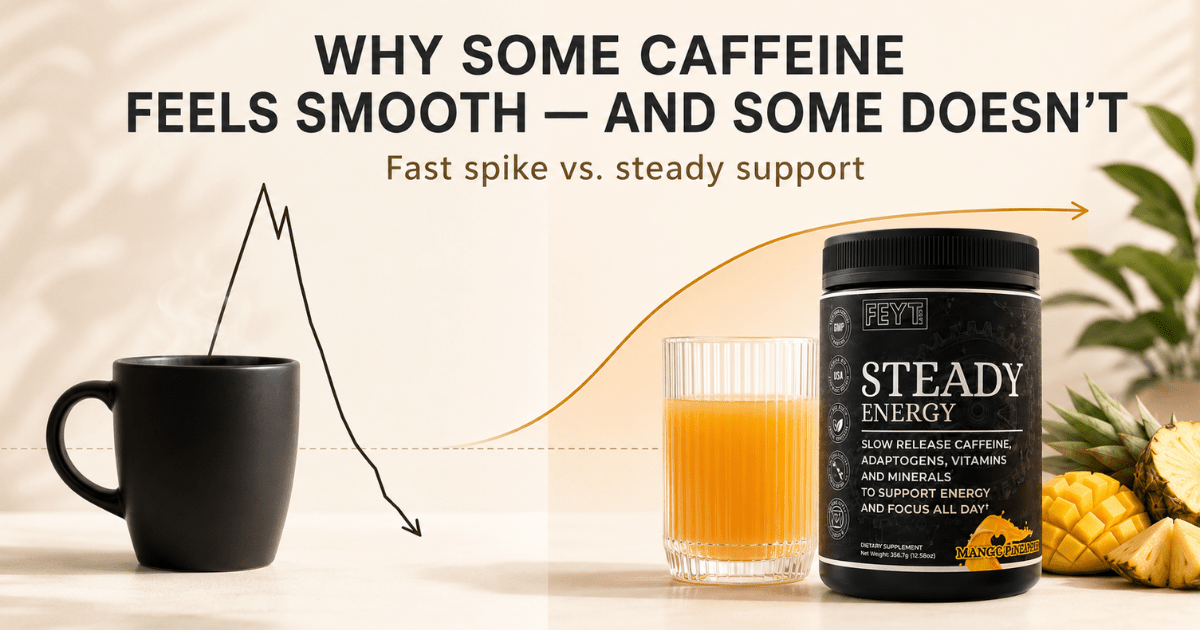
Caffeine is caffeine at a molecular level, but how fast it hits your system, what it's paired with, and what happens after the spike are all things that vary a lot depending on the source and the formula around it. That's the actual difference between a jittery crash and a steady few hours of feeling sharp.
How caffeine works in the first place
Caffeine works by blocking adenosine receptors in the brain. Adenosine is the chemical that builds up over the course of the day and makes you feel tired. When caffeine sits in those receptors instead of adenosine, your brain doesn't register the fatigue signal as strongly, which is why you feel more alert.
The catch is that caffeine doesn't actually clear adenosine from your system. It just delays the signal. When the caffeine wears off, the adenosine that's been building up the whole time rushes in at once, which is where the crash comes from. It's not just "caffeine wearing off," it's everything hitting at once that was waiting in line.
How fast that cycle plays out depends heavily on how quickly the caffeine entered your system in the first place.
What "slow-release" actually means
Most energy drinks and a lot of pre-workouts use straight anhydrous caffeine, the fast-absorbing form. It's cheap, effective, and hits fast. Which is exactly what you want before a workout. You're trying to peak quickly.
The tradeoff is that a fast peak usually means a faster drop. The harder and faster the spike, the more noticeable the comedown tends to be.
Slow-release caffeine, sometimes called extended-release or time-release caffeine, is formulated to absorb more gradually. Instead of hitting your bloodstream quickly and all at once, it's designed to release over a longer window. The intent is a steadier rise and a less dramatic drop, which maps a lot better to a 10-hour workday than to a 45-minute training session.
Why what's around the caffeine matters too
The caffeine source is only part of the picture. Two formulas with the exact same caffeine dose can feel pretty different depending on what they're built around.
L-theanine is the most studied example of this. It's an amino acid found naturally in green tea, and it's commonly paired with caffeine because research suggests the combination may help support a smoother, more focused effect compared to caffeine alone. It doesn't remove the caffeine, it's thought to take the edge off the jitteriness some people notice at higher doses.
Adaptogens like ashwagandha and rhodiola work differently, they're not stimulants. They're plants traditionally used to help the body handle physical and mental stress. Including them in an energy formula isn't about adding more stimulation, it's about supporting how the body holds up under the sustained demand of a long day.
Electrolytes are another piece most energy products skip. Dehydration affects focus and how you feel in general — and a lot of the afternoon slump people attribute to "needing more caffeine" is partly just dehydration catching up. Including electrolytes isn't a gimmick, it's just addressing something most single-ingredient caffeine products ignore.
How Steady Energy approaches this
Steady Energy uses a moderate 88mg caffeine dose alongside L-theanine, ashwagandha, rhodiola, electrolytes, and a full B-vitamin lineup. The goal isn't to build the highest stimulant load on the label, it's to build a formula where everything is working together to help support steady energy and focus across a full workday.
That's a different design philosophy than most energy drinks, which are built around hitting hard and tasting good. Steady Energy is built around still feeling functional at hour 8, not just hour 1.
What this means practically
If you've ever had an energy drink that made you feel great for an hour and then kind of hollow after, that's not a sensitivity issue, that's just the formula doing what it was built to do, which is spike fast.
A slower, more supported approach tends to feel less dramatic in both directions. You might not feel a big hit right away, and that's actually the point. The goal is even, not intense.
A few questions people ask us a lot
Is slow-release caffeine less effective than regular caffeine?
Not less effective, just different in how it delivers. The goal is a longer, steadier effect rather than a fast, sharp one. For a workday that lasts 8-12 hours, gradual tends to work better than fast for most purposes.
Why does Steady Energy only have 88mg of caffeine if other products have 200mg+?
Because more caffeine isn't always the answer, especially when you're pairing it with L-theanine and adaptogens and asking it to last all day, not just through a workout. 88mg is roughly a cup of coffee, which is enough to be an active dose without stacking stimulants on top of stimulants.
Can I feel a difference switching from a high-stimulant drink to something like Steady Energy?
Individual responses to caffeine and supplements vary, so experiences differ. Some people notice the shift right away, others take a few days for their baseline to adjust after stepping down from higher stimulant loads.
Does caffeine work better on an empty stomach or with food?
Caffeine is absorbed faster on an empty stomach, which can mean both a faster effect and a faster drop. Taking it with a light meal or snack tends to slow absorption slightly and can help reduce any stomach sensitivity some people notice with caffeine.
Bottom line
The difference between a jittery spike and a steady few hours isn't magic, it's formula design. Caffeine source, dosage, and what it's paired with all shape how it actually feels in practice. Steady Energy was built with all of that in mind, not just the milligrams on the front of the label.
Ready for energy built around the workday?
Try Steady Energy
These statements have not been evaluated by the Food and Drug Administration. This product is not intended to diagnose, treat, cure, or prevent any disease.


