

Why We Don't Hide Behind Proprietary Blends
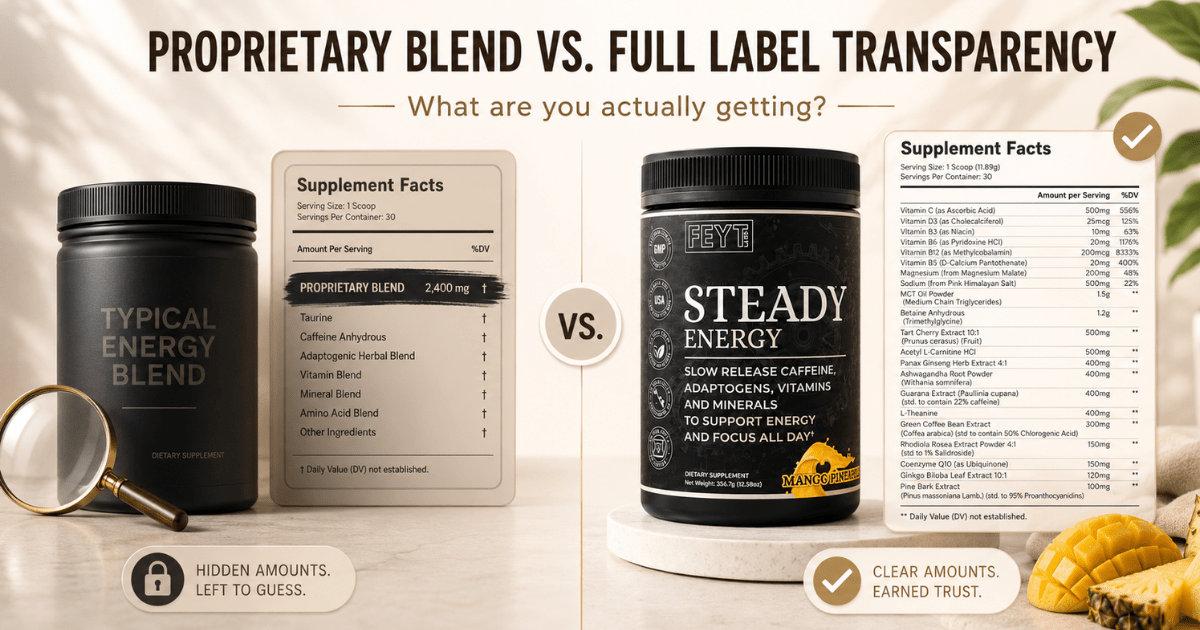
What a proprietary blend actually is
If you've ever flipped over a supplement label and seen something like "Performance Blend 2,400mg" with a list of 6 ingredients underneath but no individual amounts, that's a proprietary blend. The brand is telling you what's in the product, but not how much of each ingredient made it in.
It's legal. It's common. And it makes it genuinely difficult to know what you're actually buying.
Why brands use them
The most common reason is cost protection. If a competitor can't see your exact formula, they can't copy it as easily. That's a legitimate business concern, and some brands lean on it as a real competitive advantage.
The less flattering reason is that it allows brands to include an ingredient at a very low dose, sometimes called a "fairy dust" amount, just to list it on the label without actually delivering a meaningful amount of it. A product might advertise ashwagandha on the front of the tub while including a fraction of the dose used in the research behind it.
Either way, the customer ends up not knowing what they're actually getting.
What full label transparency means
Every ingredient in Steady Energy has an amount listed on the label. Not a blend total, each individual one. You can see exactly how much caffeine is in a serving (88mg), exactly how much ashwagandha, exactly how much L-theanine, and so on down the label.
That's not the industry default. It's a choice, and it's one we made early because the people Steady Energy is built for people who work hard, read labels, and don't want to guess what they're putting in their body deserve to actually know.
Why this matters more than it sounds
Knowing the amounts on a label isn't just about being an informed consumer in the abstract. It has some real practical implications.
If you're sensitive to caffeine, knowing there's 88mg per serving lets you make an actual decision about timing and dose. If you're already drinking coffee in the morning, you can do the math. If you're taking other supplements, you can check for overlap. None of that is possible if the caffeine is buried inside a 2,000mg "Energy Matrix."
If you're taking something like ashwagandha because you've read about it and want a meaningful daily dose, knowing exactly how much is in a serving tells you whether you're getting that or not. Proprietary blends don't let you answer that question.
Third-party testing
Label transparency is one piece. Third-party testing is the other.
Steady Energy is manufactured in a GMP certified facility and goes through third-party testing. That means an independent lab — not us — verifies that what's on the label is actually in the product, and that it's free from contaminants and adulterants.
This is the part most brands skip because it costs more and takes longer. We do it because it's the only way to actually back up what's printed on the label, and because it matters for the kind of customer who's going to read this far and ask these questions.
The FEYT Standard
We use that phrase internally to mean something specific: build the product right, show your work, and don't hide behind marketing language.
That applies to how we formulate, no proprietary blends, no fairy dust ingredients, no inflated serving sizes to make numbers look bigger on the front of the bag. It applies to how we manufacture, GMP certified, third-party tested, traceable. And it applies to how we talk about the product, no guaranteed outcomes, no exaggerated claims, no hype that the formula can't back up.
It's not a complicated standard. It's just the one we'd want held to if we were the customer.
A few questions people ask us
Why does proprietary blend use matter if the product still works?
It matters because "works" is hard to evaluate when you don't know what you took. If a product helps you, great, but if you ever want to understand why, or adjust your stack, or compare it to something else, not knowing the amounts makes that difficult. Transparency gives you something to actually work with.
Is GMP certification required for supplements?
The FDA requires supplement manufacturers to follow current Good Manufacturing Practices, but the specifics of how that's implemented and verified vary. Third-party GMP certification goes a step further, it means an independent organization has audited the facility and verified compliance, rather than relying solely on their own reporting.
Does third-party testing mean the product is FDA approved?
No, dietary supplements in the US are not FDA approved before they go to market. Third-party testing is a separate, voluntary step that verifies label accuracy and purity. It's not the same as FDA approval, but it's a meaningful layer of accountability that a lot of supplement brands skip.
Why only 88mg of caffeine when other products have 200mg+?
Because we built Steady Energy around what a full workday actually calls for, not around what looks impressive on a label. 88mg paired with L-theanine, adaptogens, electrolytes, and B vitamins is a different design philosophy than stacking stimulants. The goal was a formula that holds up across 8 to 12 hours, not one that peaks fast and crashes by noon.
Bottom line
The supplement industry doesn't require brands to show their work. We do it anyway, because the people buying Steady Energy should be able to make an informed decision, not just trust the marketing.
Full label transparency, GMP manufacturing, and third-party testing aren't features we're adding later. They're the baseline we built from.
Ready for energy built around the workday?
Try Steady Energy
These statements have not been evaluated by the Food and Drug Administration. This product is not intended to diagnose, treat, cure, or prevent any disease.


